Hanukkah
What Is Hanukkah? The Story, Meaning and Traditions of the Festival of Lights
From a small band of rebels in ancient Judea to a single jar of oil that burned for eight days – the history behind the Jewish Festival of Lights, and why its message still shines.
By the PicJew team
·
·
4 min read
Hanukkah at a glance
- When: eight nights from the 25th of the Hebrew month of Kislev. In 2026 the first candle is lit on the evening of Friday, December 4, and the last on Friday, December 11.
- Why: it marks the Maccabees' victory and the rededication of the Temple in Jerusalem in 164 BCE.
- How: lighting the menorah, special prayers, fried foods, dreidel games and family time.
Hanukkah – also spelled Chanukah – is one of the most beloved festivals of the Jewish year. For eight winter nights, Jewish homes around the world glow with candlelight, children spin dreidels and kitchens fill with the smell of fried treats. Behind the warm traditions, however, lies a dramatic story of faith, courage and a small miracle that became a lasting symbol of hope.
The historical background: Judea under Greek rule
In the second century BCE, the Land of Israel was ruled by the Seleucid Greek empire. Many Jews had adopted Greek culture, but King Antiochus IV went much further than earlier rulers. He banned the core practices of Judaism – Shabbat, circumcision and the study of the Torah – and turned the Holy Temple in Jerusalem into a place of idol worship.
For a people whose identity was built on the Torah and the Temple, this was an existential threat. Some Jews gave in. Others chose to resist.
The revolt of the Maccabees
The uprising began in the village of Modi'in, when the elderly priest Mattathias refused an order to offer a pagan sacrifice. He and his five sons fled to the hills and launched a guerrilla war against one of the strongest armies of the ancient world. After Mattathias died, his son Judah – known as Judah Maccabee, "the hammer" – led the rebels.
Against all odds, the small Jewish force won a series of battles and liberated Jerusalem. On the 25th of Kislev, 164 BCE, they purified the Temple and rededicated it to the service of God. The word Hanukkah itself means "dedication."
The miracle of the oil
According to the Talmud (tractate Shabbat 21b), when the Maccabees entered the Temple they found only one small jar of pure olive oil still sealed with the seal of the High Priest. It held enough oil to light the Temple menorah for a single day, yet it burned for eight days – exactly the time needed to prepare new pure oil.
This is why Hanukkah lasts eight days, and why its central symbol is light. The military victory showed that the few can overcome the many; the miracle of the oil showed that even a small light, kept pure, can push back a great deal of darkness.
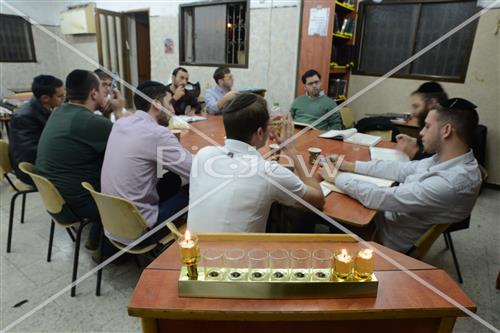 Torah study beside the Hanukkah lights – the very values the Maccabees fought for.
How Hanukkah is celebrated today
Lighting the menorah
The heart of the festival is the nightly lighting of the Hanukkah menorah, also called a hanukiah. One candle is lit on the first night, two on the second, and so on until all eight burn on the last night, alongside the helper candle, the shamash. Families traditionally place the menorah in a window or by the front door to "publicize the miracle." Our step-by-step guide to lighting the menorah explains the blessings and customs in detail.
Prayers and songs
During Hanukkah, the Al HaNissim ("for the miracles") passage is added to daily prayers and Grace after Meals, and the festive Hallel psalms are recited each morning. After lighting the candles, many families sing Hanerot Halalu and the medieval hymn Ma'oz Tzur.
Food, games and gifts
Because the miracle involved oil, it is customary to eat foods fried in oil – especially sufganiyot (jelly doughnuts) and latkes (potato pancakes). Children play with the dreidel, a spinning top whose letters recall the miracle, and many receive Hanukkah gelt – coins or small gifts. You can read more in our articles on traditional Hanukkah foods and the dreidel game.
The message of the Festival of Lights
Hanukkah is not mentioned in the Hebrew Bible, yet it has become one of the most widely observed Jewish holidays. Its message speaks to every generation: the right to live by one's faith, the courage to stand firm when it is unpopular, and the belief that light – even a single flame – will always outlast darkness.
Each night, as another candle is added, the light grows. Jewish tradition sees this as a lesson in itself: in matters of goodness and holiness, we should always keep increasing.
A little light dispels a great deal of darkness.
Looking for images that capture the spirit of the festival? Explore our collection of Hanukkah pictures, from menorahs glowing in yeshiva windows to festive tables, or browse all our Jewish holiday photos.