Hanukkah traditions
The Dreidel: Rules, Letters and the Meaning Behind Hanukkah's Spinning Top
Four Hebrew letters, a handful of coins and a spinning top that has entertained Jewish children for centuries – here is how the dreidel game works and what it really stands for.
By the PicJew team
·
·
4 min read
Few objects say "Hanukkah" as clearly as the dreidel. This small four-sided spinning top – called a sevivon in Hebrew – has kept Jewish children (and plenty of adults) entertained during the long winter nights for generations. It is simple to play, and each of its four letters tells part of the Hanukkah story.
What is a dreidel?
A dreidel is a top with four flat sides and a short handle on top. The word comes from Yiddish and means "to turn." Each side carries a Hebrew letter, and the letter that faces up when the dreidel falls decides what the player wins or loses. Dreidels are made of wood, plastic, clay, metal and even glass, and many families collect them. You can see a wide variety in our dreidel picture collection.
The four letters and their meaning
Outside Israel, the four letters are:
- Nun (נ)
- Gimel (ג)
- Hei (ה)
- Shin (ש)
Together they stand for the phrase Nes Gadol Haya Sham – "a great miracle happened there," referring to the victory of the Maccabees and the miracle of the oil in Jerusalem.
Why Israeli dreidels are different
In Israel, the fourth letter is Pe (פ) instead of Shin, for Nes Gadol Haya Po – "a great miracle happened here." A dreidel from Jerusalem and one from New York tell the same story, each from where its owner stands.
How to play dreidel: the rules
All you need is a dreidel and a pile of tokens – chocolate coins (gelt), nuts, raisins, candies or buttons.
- Each player receives the same number of tokens, for example ten or fifteen.
- Every player puts one token into the middle, called the pot.
- Players take turns spinning the dreidel. When it falls, look at the letter facing up:
- Nun – nothing happens; the turn passes to the next player.
- Gimel – the player takes the whole pot.
- Hei – the player takes half the pot (round up when the number is odd).
- Shin (or Pe) – the player puts one token into the pot.
- Whenever the pot is empty, or has only one token, everyone adds one more.
- A player who runs out of tokens is out. The game ends when one player has everything – or when it is time for doughnuts.
A helpful way to remember the rules is through the Yiddish words that begin with the same letters: nisht (nothing), gants (all), halb (half) and shtel ayn (put in).
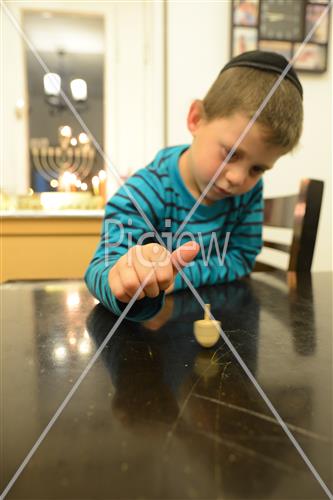 Spinning the dreidel – a Hanukkah game for all ages.
The history of the dreidel
A popular tradition holds that during the Greek decrees, when Torah study was forbidden, Jewish children studied in secret. When soldiers approached, they hid their books and pulled out spinning tops, pretending to be playing a game. Whether or not the story is historical, it beautifully captures the spirit of Hanukkah: holding on to faith and learning in difficult times.
Historians note that similar spinning-top games were common in medieval Europe, including a German game with letters for "nothing," "all," "half" and "put in." Jewish communities adopted the game and gave its letters a new, Hebrew meaning connected to the miracle.
A hidden message in numbers
In gematria, the system that gives each Hebrew letter a numerical value, Nun, Gimel, Hei and Shin add up to 358 – the same value as the word Mashiach, the Messiah. For many, this turns a children's game into a reminder of hope for the future redemption.
Variations on the classic game
Families have invented many twists on the traditional rules. Some play "dreidel tournaments" with brackets and small prizes. Others assign a question or a Hanukkah fact to each letter, turning every spin into a quiz. In Israel, giant dreidels appear in shopping centers and schools, and some cities hold competitions for the biggest or longest-spinning dreidel. However you play, the goal stays the same: time together and a story worth remembering.
Dreidel ideas for families and educators
- Hold a spinning contest: who can keep the dreidel turning the longest?
- Decorate plain wooden dreidels with paint, markers and stickers.
- Use the four letters to retell the story of Hanukkah, one letter at a time.
- Play in the glow of the menorah, during the half hour after lighting the candles.
Teachers, designers and bloggers looking for visuals will find authentic dreidel photos and illustrations, along with many more Hanukkah pictures, in the PicJew library.